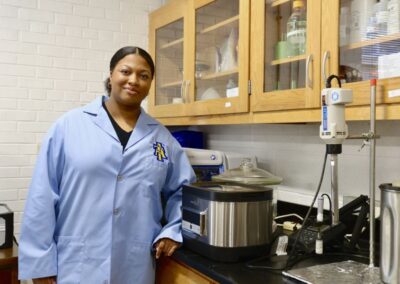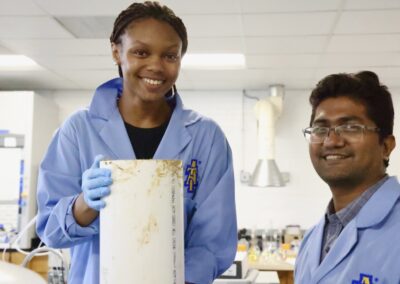
Durham native Eden Harris traveled through Greensboro many times in her youth and enrolled at N.C. A&T because of family connections: Her mother, speech pathologist Rolesha Andrews Harris, is an Aggie alum.
“Hearing about her experience, I felt inspired to follow in her footsteps and build my own legacy,” Harris recalled. “I wanted to attend a university with like-minded individuals. After I asked a friend of mine for a tour, she told me I would fall in love with campus, and I absolutely did.”
Harris earned the Aggie Merit Scholarship, cementing her decision to enroll at A&T in 2021 to pursue a degree in biology and one day become a physician assistant. Her academic journey would soon take another direction.
“I liked biology, but I wanted to get more involved in research,” she explained. “I looked into labs across campus, connected with a mentor, then joined the Food Microbiology and Biotechnology Lab. I truly loved the aspect of food and biology, so I decided to change my major to fit me better and keep biology as my minor.”
In Fall 2022, Harris enrolled in the College of Agriculture and Environmental Sciences’ food and nutritional sciences program, housed in the Department of Family and Consumer Sciences. She excelled academically, with a list of achievements that include the CAES 1890 Scholarship, the Next Gen 1890 Scholarship and, prior to her graduation in 2025, the Undergraduate Research Scholars Program.
“I had joined (former food science professor) Dr. Salam Ibrahim’s lab as a junior,” Harris said. “For me, the program was like a deeper dive into research and why it’s important to learn about research development skills.”
Her project focused on developing a laboratory medium to grow Lactobacillus bulgaricus, a lactic acid bacterium widely used to help ferment dairy products as a starter culture and considered a probiotic. “Probiotics are very important for your gut health,” she said.
However, according to Harris, nitrogen sources that help form Lactobacillus bulgaricus media — the standard of which, MRS (de Man, Rogosa and Sharpe agar), contains meat extracts such as pork and beef — are expensive. Harris was faced with a challenge: What would be a less costly, yet just as efficient, substitute for MRS and meat-based extracts?
“Several agricultural products are rich in proteins, vitamins and carbohydrates, and thus have great potential to be partially or fully utilized to replace the expensive ingredients in Lactobacillus bulgaricus media and thus lower costs,” she said.
The vegetable of choice? Cucumbers. “Cucumbers are great fermenters … and they can develop bacteria pretty well.”
Using freshly juiced cucumber as the control group, Harris mixed the juice with a buffer to create a solution, then tested the bacteria growth of her nitrogen sources, comparing the standard MRS media in one tube to another tube containing yeast extract.
The results were encouraging.
“The nitrogen sources, between the MRS and the yeast extract, all performed similarly,” she said. “Overall, medium developed from cucumber could be used as an alternative growth medium for cultivating Lactobacillus bulgaricus for fermentation purposes in industrial settings.”
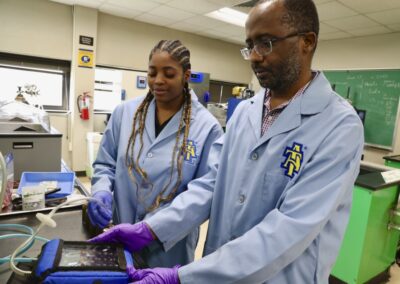
Harris worked closely with Ibrahim as a project advisor. After Ibrahim’s retirement in February 2025, she completed the project with the assistance of food science professor Reza Tahergorabi, Ph.D.
“Working with Dr. Tahergorabi has been very helpful when it comes to next steps for me as a senior,” Harris said. “He’s also encouraged me to take my research and present, including a research presentation at Yale.”
In return, Tahergorabi complimented Harris.
“Eden is very interested in working as a team and is a very detail-oriented student,” he said. “I also believe the URSP program helped enhanced her skills in critical thinking. Now she can apply her knowledge anywhere in the industry or academically.”
Since graduating in Spring 2025, Harris has focused on securing a job within food science related to product development and quality assurance, with plans to attend graduate school in the near future.
“I intend to use this time in the workforce to explore different areas of interest and ensure that I make an informed decision on the specific graduate degree program I join,” she said.