Tiyanna Anthony: Turning Milk Quality Queries Into Undergrad Research
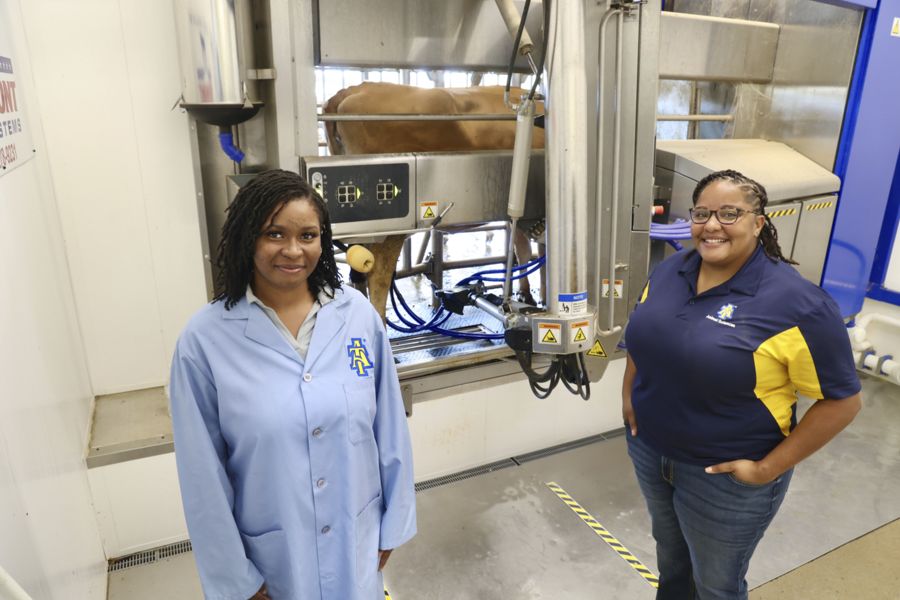
Animal science major and URSP Tiyanna Anthony (left) with assistant professor Lauren Mayo, Ph.D. at the Dairy Unit's Voluntary Milking System at the N.C. A&T State University Farm.
A quiz bowl in high school set in motion Fayetteville native Tiyanna Anthony’s path to practicing animal science and researching the quality of milk.
“My teacher encouraged me to join the Horticulture Quiz Bowl as a competitor,” said Anthony, an animal science major and Undergraduate Research Scholar. “After taking his class, I took another agriculture class where they had a farm they would take us out to. … I’d always loved animals, but seeing that it could also be done in a professional setting inspired me to continue with my education.”
Deciding to attend N.C. A&T in 2021 was easy, she said. The university was close to home and was the only HBCU in North Carolina with an animal science program.
But there was more.
“Growing up at predominately white schools, you felt out of place at times and you were always the center of attention. When I got here, I felt comfortable and that I didn’t have to put up a facade,” Anthony explained. “The animal science program, more specifically, is a very close family dynamic. Everybody knows each other and it was very welcoming.”
Anthony has taken part in many extracurricular organizations within the College of Agriculture and Environmental Sciences, including the Pre-Veterinary Club and Dairy Science Club, as well as the N.C. A&T chapter of Minorities in Agriculture, Natural Resources and Related Sciences (MANRRS). The latter proved instrumental in aligning Anthony with her eventual mentor, Lauren Mayo, Ph.D.
“Our first interaction was when she joined MANRRS,” said Mayo, an assistant professor. “One of the first things I noticed was that she was really good at public speaking and was not afraid to talk about the science behind the things that she had learned. She later joined my lab as a volunteer and not only constantly showed up but was reliable. Now, she’s built up a level of skill to where I can leave her with the cows or leave her to take samples by herself, and I can’t say that for every undergrad student.”
Anthony began work as an Undergraduate Research Scholar in August 2024, focusing on the effects of grazing on the pasture and milk quality, milking yield and frequency of A2A2 Jersey cows.
“We were looking at the seasons of weather temperature, seeing how the height of the grass can affect how much milk the cows can produce, how much the cows can be milked per day, and the components of the milk like composition,” she said.
On mornings before the cows were moved to a new pasture, Anthony performed forage sampling, measuring the height of random areas of grass by using a 4x4 PVC pipe.
“Twenty times a day, I’d throw the pipe into the pasture, measure the tallest blades of grass from the middle and corner spots of the square, and get a good idea of how much pasture is available,” she said. “I’d record it, take a sample of each time that I threw the square, and collect that in a bag for further nutrient analysis.”
From there, Anthony collected samples of the cows’ total mixed ration — a combination of grains, forages, minerals and protein supplements — up to 10 times a day. Then, Anthony and Mayo monitored the quality and quantity of milk production through the farm’s Voluntary Milking System, a digital milker that not only allows the cows to be milked multiple times a day but measures flow rate, conductivity, milk yield by teat and other factors.
“The results that we’ve found so far have shown the more protein that we saw in the quality forage led to an increase in milk production and frequency,” Anthony said. “We also discussed that increased rainfall had improved the quality in forage and that a medium-size height versus a higher height was more nutritious and leading to better milk production.”
Anthony has made clear that after she graduates in December 2025, there’s only one place for her to continue her education.
“My next steps are getting my master’s degree at A&T, and then eventually vet school,” she said. “My last four years were definitely a journey of growth, getting out of my shell, networking, seeing what things I liked and didn’t like in the animal science industry, and seeing that there’s more to animal science than just being a veterinarian.”