For Hayla Scott, the Undergraduate Research Scholars Program offered a two-pronged opportunity: to expand her knowledge of veterinary science and to step out of her comfort zone.
The Charlotte-born native, who graduated Spring 2025 with a B.S. in animal sciences and a certification in biotechnology, knew at a young age what she wanted to do with her life.
“I’ve been interested in animal sciences since I was 7,” Scott said. “From that age, I’d always wanted to be a veterinarian and to study and help animals.”
Scott based her decision to attend N.C. A&T on the positive things she heard about the College of Agriculture and Environmental Sciences. “I wanted to go to an HBCU that specifically had a really good animal sciences program,” she said.
Scott enrolled in CAES’ Department of Animal Sciences in 2021 and soon built an impressive resume: membership and leadership roles in the college’s Pre-Veterinary Medical Association and Gamma Sigma Delta’s Agricultural Honor Society, as well as being named a CAES 1890 Scholar. One program, however, had been on her mind for a long time: the Undergraduate Research Scholars Program.
“This is something that I’ve wanted to be a part of for many years now,” Scott said.
The one- to two-year program for juniors and seniors provides a thorough grounding in real-world research methods by working closely with faculty in one of the four departments in the college.
“Students who apply and are chosen by the program are supported by a stipend and encouraged to share their research at conferences as well as in publications,” said CAES interim dean Radiah Minor, Ph.D. “They also take a few extra courses and, as a cohort, share their presentations to the college.”
After being accepted into the program her junior year, Scott chose to work in Minor’s lab, tackling a unique project that looked to curb inflammation in animals without turning to traditional medicine. At the time Minor was a professor and head of the animal sciences department.
“In animals inflammation can impact quality of life, such as gut health, reproduction and joint function,” she explained. “Non-steroidal anti-inflammatory drugs (NSAIDs) such as Tylenol and Ibuprofen can reduce inflammation by masking symptoms without addressing causes, but long-term use can cause organ damage.”
The objective, Scott said, was to identify natural plants that can be used as feed for animals to reduce inflammation. For this, Scott and Minor turned to Moringa oleifera, a nutritious medicinal tree native to Northern India. The aptly named “Miracle Tree” is known for reducing inflammation and providing multiple health benefits, such as anti-cancer and antioxidant potential. Moringa can be used as a feed supplement for both humans and animals, including livestock.
Through western blotting — an analytical technique that detects specific proteins in a sample of tissue homogenate or extract — Scott and Minor looked at how Moringa could activate Nuclear Factor kappa B (NF-κB), the family of transcription factor protein complexes that, when dysregulated, impacts T-cells and causes chronic inflammation and autoimmune disorders.
“We found that Moringa oleifera is a promising feed supplement for impacting inflammation, and that it does reduce NF-κB, but the plant’s role in T-cells specifically is still unknown,” Scott said. “The lab will continue to investigate Moringa’s effect on NF-κB in T-cells using western blotting.”
Minor remembers Scott as an intelligent and dedicated student.
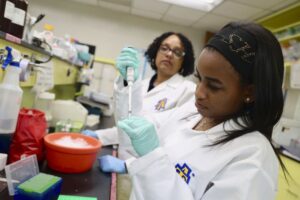
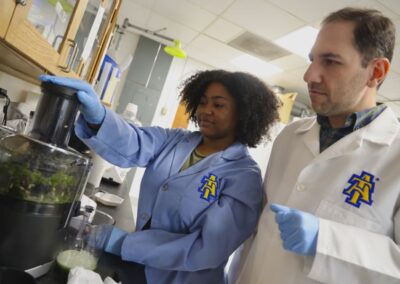
Scott, right, works in the lab with Minor. The study’s objective is to identify natural plants that can be used as feed for animals to reduce inflammation.
“Everything that we’ve asked her to do in the lab — there’s the didactic parts of actually doing the technique, but then there’s the creating figures and presenting them and understanding more about the technique and why we are doing the things that we’re doing — she’s done a great job of comprehending those things and explaining them,” Minor said.
Scott, who plans to enroll in veterinary school in the near future, said she found the program to be an outlet that challenged her both academically and personally.
“I hope to leave behind advice for undergraduates in this program or otherwise that they can definitely push themselves to apply to anything that they want and push themselves out of their comfort zone,” she said. “And with Dr. Minor, she really pushes her students to succeed and I’ve learned a lot of new techniques with her in the lab and focused on trying to perfect them.”