A former pre-med major turned food science student, Undergraduate Research Scholar Alyssa Simon is tackling the best way to replace — and prepare — a popular imitation fish with a product that provides the same good taste but better benefits to the consumer and the environment.
“Public health is important to me,” said Simon, a senior in the food and nutritional sciences program. “Originally, I wanted to be a pre-med student, so starting off with public health I understood the systems and policies in the hospital structure for when I would eventually become a doctor and maybe work in a hospital.”
Simon, a native of Atlanta, attended the University of Alabama in Birmingham for her freshman and sophomore years before taking a “leap of faith” to switch schools and majors in 2023.
Shifting her interest to food science as a way to continue her study of human health, Simon specifically sought options at HBCUs that were approved by the Institute of Food Technologists, an international, nonprofit scientific society engaged in food science, food technology and related areas in academia, government and industry.
“There’s two HBCU programs that I considered, A&T and Tuskegee. A&T gave me more credit hours when I transferred,” she said.
Arriving at N.C. A&T’s College of Agriculture and Environmental Sciences was a welcoming experience for Simon.
“I remember the first day that I came here and sat up in my dorm, and the first thing that I heard was the band performing outside,” she said. “It felt like this was where I was supposed to be… . I just loved the energy here and felt right at home.”
Simon has been duly rewarded for her decision to transfer to A&T, earning the Aggie Chobani Scholarship in 2024 as well as research and development internships with food companies Mondelēz International and Danone.
Taking part in the college’s Undergraduate Research Scholars Program, Simon put the knowledge she’s acquired to the test in looking at a healthy, sustainable and all-around delicious replacement for surimi, minced fish meat used to create imitation seafood.
“The environmental concerns for traditional surimi are wastewater, overfishing, mercury content, microplastics, as well as the general animal welfare of the fish,” she explained. “What we’re attempting to do is switch to a plant-based surimi. Before my project, there was a master’s student working on this who decided what the formula would be. From when that formula was decided, and understanding the ingredients and what their functionality would be, it goes into creating the product.”
The next question centered on the best method to cook the alternative surimi: deep-frying in canola oil, or a vacuum-sealed, water bath approach in sous vide? For the experiment, three plant-based test formulations — a soy protein isolate, a pea protein and a 50/50 combination — were cooked using both methods and then compared in gumminess, chewiness, color and fat content against a traditional fish surimi.
“The idea with deep-frying is that it would create a harder and gummier texture, and then through testing, we would see even if it was gummier and harder, if it would be pleasant for consumers,” she said.
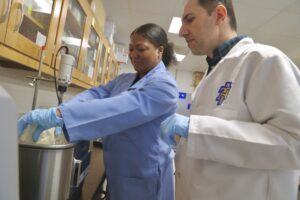
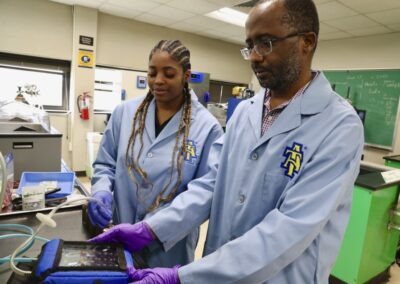
Simon and food science professor Reza Tahergorabi, Ph.D., test the cooking properties of plant-based surimi through the sous vide cooking method.
Thus far, Simon has determined that both deep-frying and sous vide “significantly impacted” the quality of the plant surimi, with the latter being preferable in uniform color and texture, while deep-frying resulted in a darker color, harder texture and higher fat content.
“What really determined the difference in our sous-vide and deep-frying product was the puncture test, in looking at the gumminess, chewiness and hardness,” she said. “We determined that the deep-frying gave us a harder, gummier and chewier texture.”
For her project, Simon was mentored by Reza Tahergorabi, Ph.D., a food science professor whom she credits for both the success of the experiment and navigating the new food science realm.
“Beyond her technical skills, Alyssa is a very dedicated student working in the lab,” Tahergorabi said. “She’s very motivated and able to work independently. I think the skills that she learned throughout this project will be beneficial in the jobs she’s pursuing.”
Simon, who graduates in December 2025, plans to pursue a job in the food science industry.