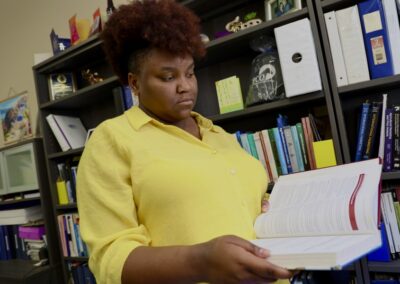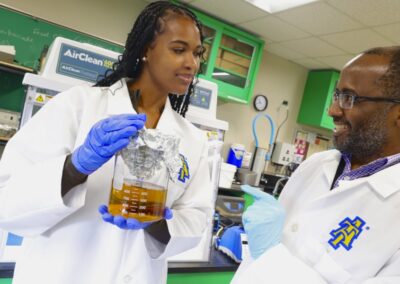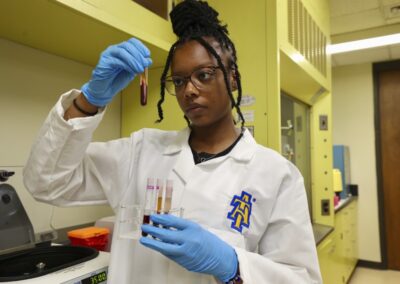
Second-generation Aggie Kevin Battle Jr. is on the hunt to see how fish waste can positively impact soil-free plants and save farmers money along the way.
Battle, a 2025 Undergraduate Research Scholar studying biological engineering, has always held a strong interest in agriculture’s application to protecting wildlife and the ecosystem.
“I’m very interested in the broad range of agriculture,” Battle said. “We do study a lot of agricultural systems in this department, but these practices can be applied to a wide variety of systems, especially in an ecological sense.”
The son of two N.C. A&T alums, Battle chose to follow in his parents’ footsteps and join the Aggie family.
“It’s always been 20 minutes down the street, and with my parents attending I’m sort of a legacy,” he said. “It took some getting used to, because it’s a new environment from high school vs. college, but overall A&T has been very welcoming.”
Enrolling in the College of Agriculture and Environmental Sciences in 2021, Battle called CAES a “close-knit environment,” particularly in the biological engineering program, housed in the Department of Natural Resources and Environmental Design.
“Biological engineering is very small,” he explained. “You know all your professors and they know you by name. Small class sizes. It’s a really good community if you want to work closely with others.”
As an Undergraduate Research Scholar, Battle looked for a topic of his own interest to study: aquaponics, the raising of fish and utilizing their waste to cultivate soil-free crops.
Initially, I was part of a community outreach program through ASABE (American Society of Agricultural and Biological Engineers), and we were at a local community garden where they had this aquaponic set up,” he said. “I wanted to see if there was an avenue for research, since it hadn’t been done as much on campus.”
Using a small-scale aquaponic system — in this case, a 40-gallon fish tank — with 30-40 goldfish, Battle studied the impact on urban agriculture through the system’s relationship with a hydroponic tower, a vertical, soil-free plant system that feeds crops through nutrient-rich water.
“In the study, we feed the fish like normal, then we take their waste and put it through this hydroponic tower,” he said. “We’re filtering this nutrient-rich water over these plant roots and then cultivating the crops. I’m testing these against a control, which would be commercial-grade nutrient, and basically seeing if it is not only economically feasible to run an aquaponic system, but if it can compete with the growth rate of commercially purchased nutrients.”
Battle completed the experiment in Spring 2025, but has continued the research following promising, yet preliminary results.
“We noticed there may be a lack of certain compounds when it comes to the fish waste and that may have led to a drop-off in growth rate,” he said. “So this semester, we want to be more thorough with our testing and our water analysis and making sure none of the fish waste is lacking any of these compounds.”
Blessing Masasi, Ph.D., is Battle’s research mentor. He praised the undergraduate scholar.
“He has been doing all that needed to be done in terms of being a good researcher,” said Masasi, an assistant professor of biological engineering. “He’s done literature reviews, he came up with the methods, the tools and the equipment that we need. We set up the equipment, and he has been taking all of the data. It has been a good relationship.”
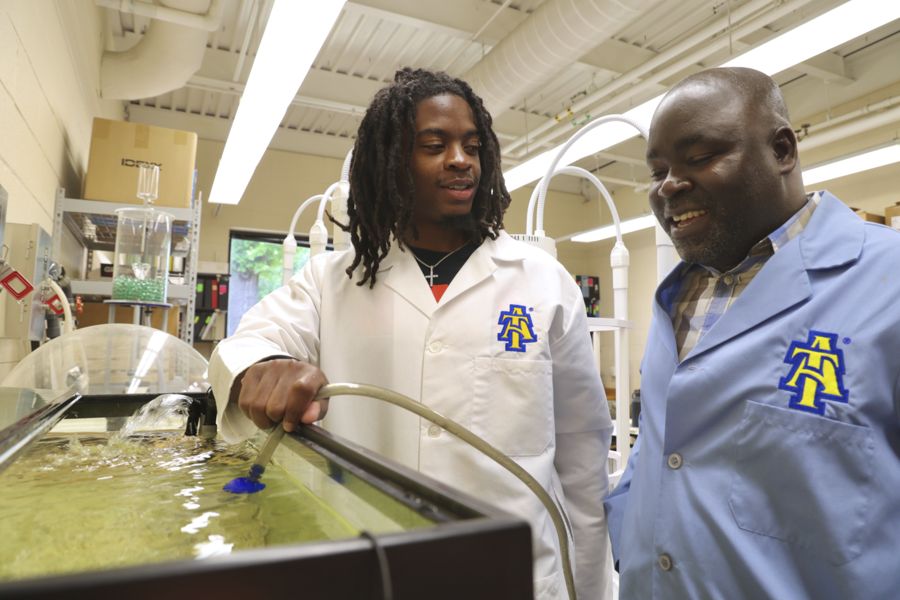
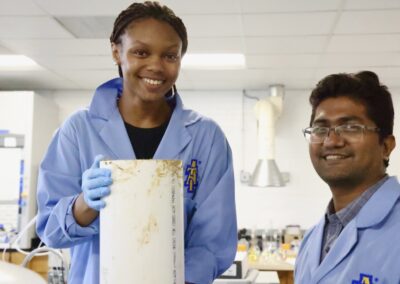
Battle, left, works in the lab alongside his research mentor, Blessing Masasi, Ph.D.
Aside from his research, Battle’s four-year Aggie journey included such opportunities and accomplishments as the Natural Resources and Conservation Services Scholarship, three years as a student member of ASABE, two years as a student engineer intern with the U.S. Department of Agriculture, as well as a marine biology internship with UCLA.
“These last four years have really molded my character and made me decide what I want to do with my life,” he said. “I’ve had plenty of opportunities through research, and that’s really allowed me to narrow down which avenues I want to take.”
Battle graduates from N.C. A&T in December 2025 and intends to enroll in graduate school.