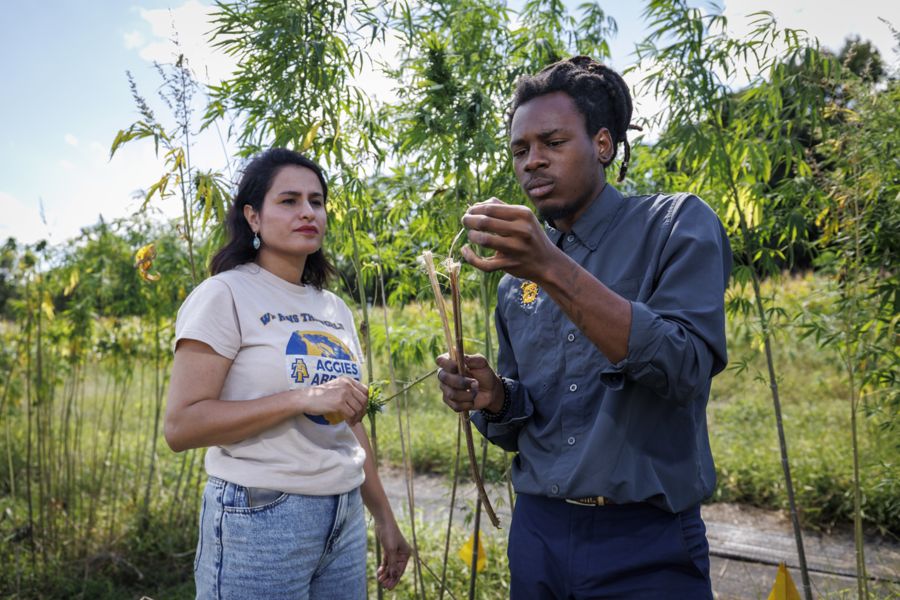

Arnab Bhowmik, Ph.D. Associate Professor, Dept. of Natural Resources & Environmental Design abhowmik@ncat.edu
A crop cultivated for thousands of years is being reimagined at N.C. A&T, where researchers are focusing their work on hemp for fiber and seeds, shifting away from the CBD-dominated market of recent years.
Leading these efforts is Arnab Bhowmik, Ph.D., associate professor of soil sciences and director of the Soil Sustainability Lab, whose team aims to unlock hemp’s modern potential for North Carolina’s farmers.
Although ancient, hemp was only recently legalized for research and commercial uses in North Carolina. The 2014 Farm Bill opened the door for hemp pilot projects. North Carolina’s two land-grant universities – N.C. A&T and North Carolina State – were part of a federal pilot program launched in 2015 to study hemp’s agricultural possibilities. Early investigations emphasized CBD varieties, as well as the economics of hemp production.
With the 2018 Farm Bill authorizing low-THC hemp production nationwide, farmers rushed to cultivate hemp for CBD oil and other products. But an oversupply and market crash left many with unsold crops, prompting A&T’s hemp program to reconsider priorities.
“There was a huge bubble around CBD hemp. The market was flooded, and farmers didn’t have contracts with extractors. A lot of buds were left to rot,” Bhowmik recalled.
Adding to the difficulties posed by the market glut, regulations require farmers to keep THC (the psychoactive chemical found in hemp plants that differentiates it from marijuana) to 0.3% or below. Regular testing is required, and farmers can lose their entire crop if cannabinoid content creeps above the legal threshold. In response, hemp research at A&T shifted attention from CBD to fiber and grain/seed varieties, which promise more dependable industrial markets and uses ranging from textiles and construction to animal feed.
“There’s growing demand for fiber hemp, especially from the textile, auto, and construction industries, which is fueling our research,” Bhowmik said.
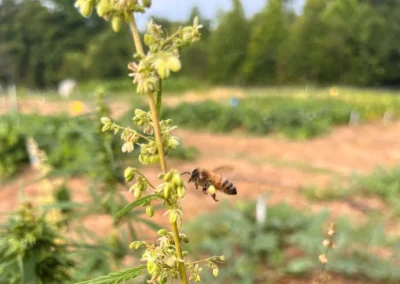
Hemp fiber, which comes from the stalks, rather than the flower buds, can be blended with cotton for textiles, pressed into fire-resistant construction materials known as “hempcrete,” or incorporated into automobile parts, he said. Hemp grain is increasingly valued, also, as a protein-rich food ingredient and animal feed.
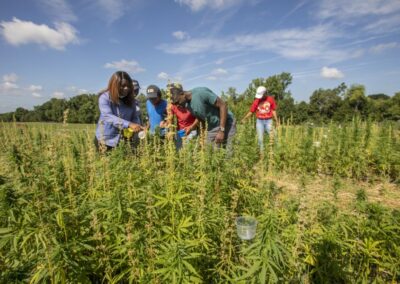
Arnab Bhowmik, Ph.D., discusses drying hemp stalks with Mariam Qambar Baysa, center, and Narjes Gorgin, both doctoral students. Bhowmik’s goal is to provide practical recommendations to small-scale farmers so that they can grow “fiber hemp” successfully.
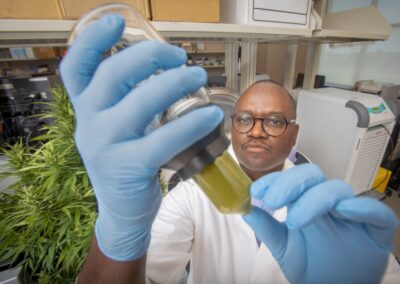
Today’s hemp research at A&T is multifaceted. In the lab, Bhowmik studies hemp’s rhizosphere, or root zone,a dynamic and mutually beneficial zone in soil where plants and soil organisms communicate and cooperate to keep plants healthy and growing.
“Hemp roots act like a tiny kitchen and as the plant grows, it releases a mix of sugars, proteins and other compounds called exudates,” said Bhowmik. The root exudates shape interactions with soil minerals and microbes, he added.
A recent publication in Rhizosphere co-authored by Bhowmik describes the first use of microfluidic technology in the form of a “RhizoChip” (rhizosphere-on-a-chip) to study hemp root exudates. By growing hemp seedlings on chips infused with soil-like minerals such as kaolinite and feldspar, the researchers discovered that root growth depends on mineral presence. Without minerals, roots stalled; with them, they thrived.
In the field and greenhouses, Bhowmik’s team tests fertilizer strategies for fiber hemp, including blending chemical fertilizers with organic sources like poultry manure and biochar made from hemp stalks. Early results show that combined approaches promote healthier, more robust plants and improve soil structure.The goal, said Bhowmik, is to provide practical recommendations so small and limited-resource farmers can successfully grow hemp and become part of new supply chains.
“We want to reduce chemical use and recycle nutrients wherever possible,” Bhowmik said. “And we want to help farmers choose varieties that work for their soil and local climate.”
One such farmer is Patrick Brown, owner of Brown Family Farms in Warren County and 2024’s Small Farmer of the Year. Brown first grew CBD flower hemp in greenhouses, selling value-added products under the Hempfinity brand. As the market shifted, he transitioned to fiber hemp, expanding to 350 acres across three counties. Today, Brown’s product is sold to BIOPHIL Natural Fibers, a North Carolina firm that supplies well-known clothing brands aiming for sustainable, traceable sourcing.
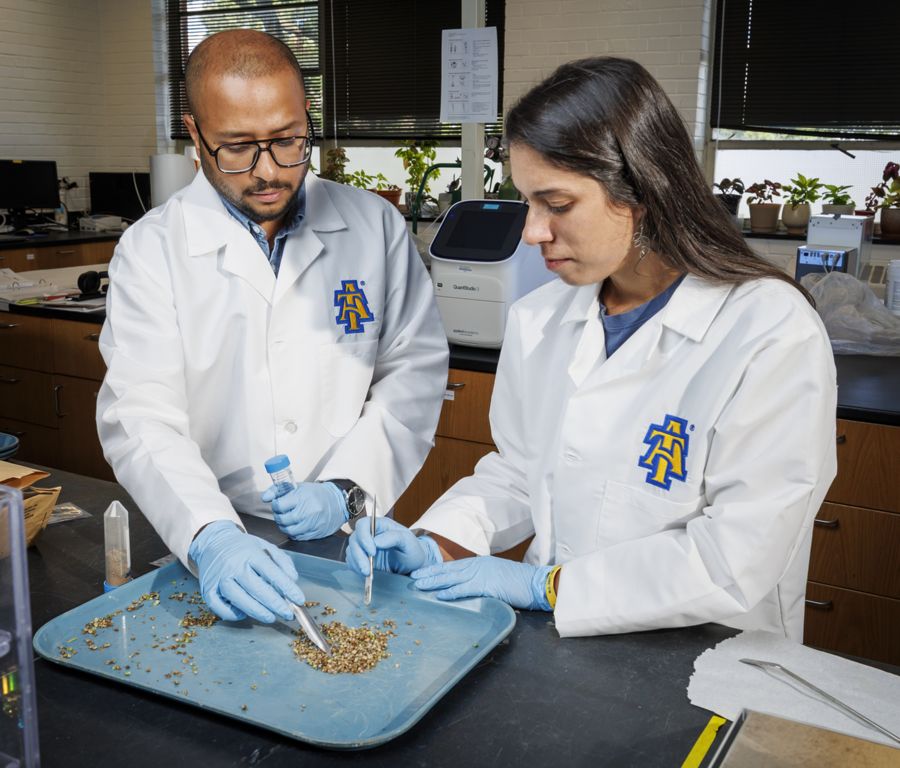
Bhowmik and Qambar Baysa evaluate hemp seeds. “We have to open new scientific avenues, but ultimately, it’s about improving stakeholders’ lives,” Bhowmik said.
“Traceability back to the farm is essential for a company like BIOPHIL,” Brown noted. “They require organic methods, soil analysis, and yearly rotation.”
Brown uses hemp to remediate soil on fields once used for tobacco – a bonus for environmental sustainability. He credits his success to building multiple market streams and staying flexible. “You have to have buyers in place and always a plan B and C. Collaboration with other farmers and researchers is key,” he said.
Looking forward, the A&T hemp program aims to balance fundamental research and practical field applications. Bhowmik sees this combination as key to helping farmers prosper while pioneering new knowledge about soil health and sustainable crops.
“Both fundamental and applied research are needed,” he said. “We have to open new scientific avenues, but ultimately, it’s about improving stakeholders’ lives.”
Future outreach efforts will include more on-farm demonstrations and educational events, inviting farmers to see experiments firsthand and discover how fiber and seed hemp might fit their operations.
“Hemp has enormous potential to diversify crops, restore soils, and provide new income streams,” Bhowmik said. “If we do it right, it can live up to its promise and help build a sustainable future for North Carolina agriculture.”