Hao Feng and his team are finding ways to enhance the nutrition, color and safety of the increasingly popular crop.
For urban farmer Garrett Corwin, the results of research at NC A&T into the use of lasers to make microgreens more vibrant and nutritious are a win-win.
“The color enhancement sounds great — that’s something that would be appealing to our (restaurant) customers,” said Corwin, who owns Piedmont Microgreens in Durham. “And people that buy from us at the farmers market — those people, I’m sure, want a pretty plant, but probably care a lot more about the nutritional value.”
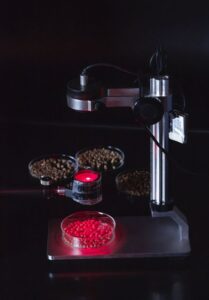
Microgreen seeds are treated with lasers to create more nutritional and vibrant plants.
The research is being led by Hao Feng, Ph.D., a professor of food and bioprocess engineering. Feng and his team treated broccoli and radish microgreen seeds with lasers, which significantly enhanced germination and growth metrics in both microgreens compared with untreated seeds.
“We have the stimulation of light at certain wavelengths and certain frequencies,” said Feng, who also is director of the Urban and Community Food Complex, part of the College of Agriculture and Environmental Sciences.
“When seeds grow, they have a response system,” Feng explained. “In this process, the laser treatment can trigger a certain pathway of the synthesis of nutritional molecules that we call bioactive molecules.” Those molecules, such as phenolic compounds, are good for health.
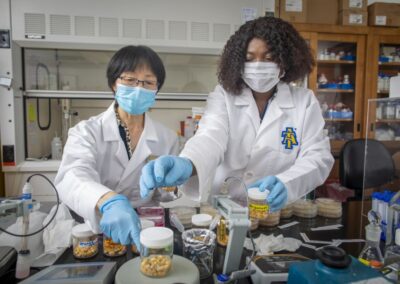
Hee Kyung Park, Ph.D., a temporary research associate in food safety, and Hanieh Sadeghi, a doctoral student studying food science, are assisting Feng with the research at A&T’s University Farm.
The research on microgreens also examines the use of different substrates — the material on which an organism grows — including coco coir, peat and cotton substrates, with and without laser treatment.
Laser treatment significantly improved germination, growth and bioactive compound concentrations, with coco coir emerging as the optimal substrate for both broccoli and radish microgreens, Feng found.
The A&T research also extends to improving food safety, though that experimentation is just getting started.
From 1996 to 2020, sprouts were linked to about 50 outbreaks in the U.S., causing more than 2,500 illnesses, according to the website Food Poisoning News. The outbreaks mainly were associated with salmonella or listeria contamination.
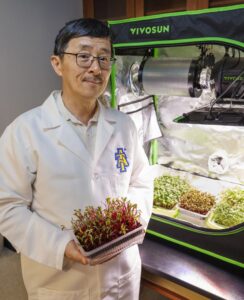
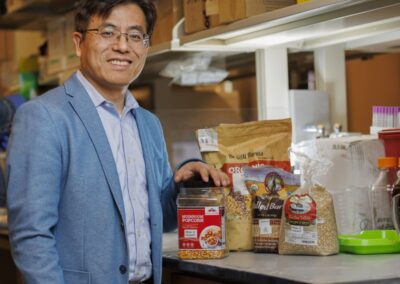
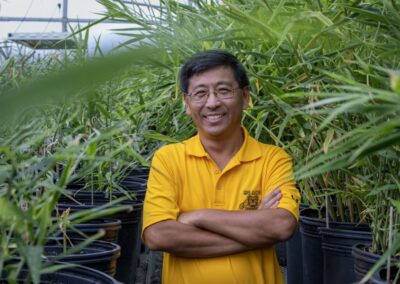
Hao Feng, Blue Cross/Blue Shield Endowed Professor of urban food systems, within the College of Agriculture and Environmental Sciences, is researching ways to enhance the nutrition, color and safety of microgreens.
Microgreens present similar food safety risks as sprouts because they share similar growing conditions, Feng said. The primary sources of foodborne pathogens are from contaminated seeds or from the harvesting process, the tools of which include micro-scale gaps and folds that can be difficult to sanitize, he said. The water circulation system and growth medium also can be vectors for cross-contamination.
“If you grow microgreens, you have water, you have nutrients — and they create a very good condition for bacteria to grow,” Feng said.
Enhancing the safety of microgreens starts with treating the seeds to kill bacteria. “If there’s only one E. coli cell on a seed, if you grow the seed, after maybe seven days you can multiply to 100,000 in terms of E. coli,” Feng said, referring to a group of bacteria that can cause infection. “It’s very dangerous.”
Current Food and Drug Administration standards call for using a strong chlorine wash to treat seeds, but Feng said concerns have been raised that byproducts of these substances may be linked to potential cancer risks.
“We want to have a new method to make sure it is safe,” Feng said. That method involves using a laser to activate a photosensitizer, a molecule that absorbs light energy and transfers it to other molecules, causing chemical reactions that can kill the bacteria.
Another aspect Feng is examining is the plant microbiomes — a community of diverse microorganisms that include such things as bacteria, fungi and viruses — to understand the risk of contamination and the growth during production.
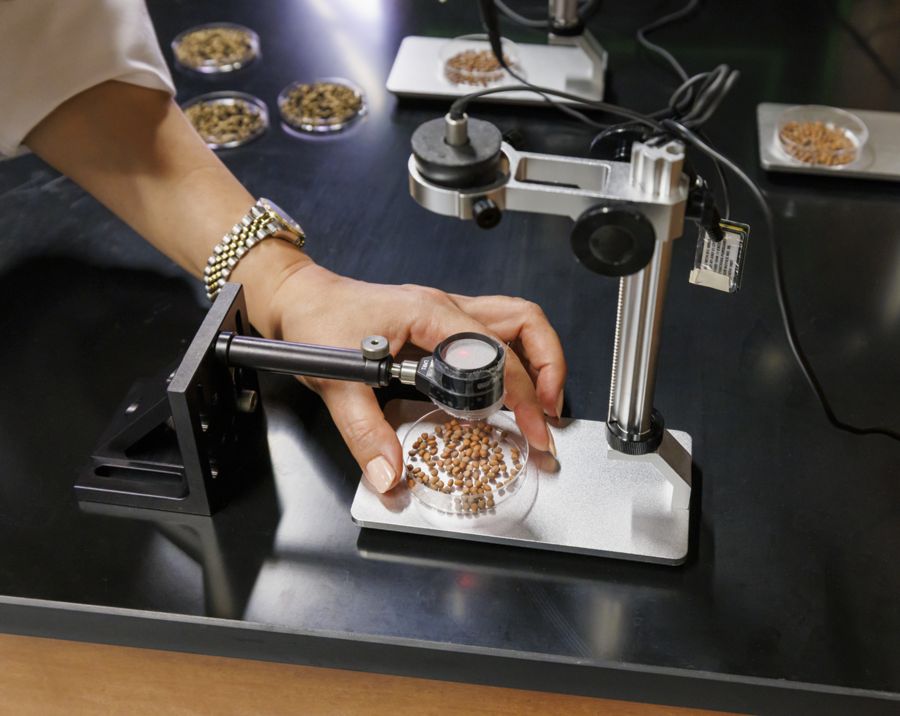
Hanieh Sadeghi, a doctoral candidate working with Feng, places microgreen seeds under a laser and diffuser to enhance germination and growth.
“Because there are a lot of bacteria, not just one or two different species, they can grow and compete. So, we want to look at and understand the population change ecology during growth, and that’s why we want to look at microbiome,” he said.
Feng hopes to share this technology with the local community through the Urban and Community Food Complex at the University Farm. The hydroponic niche crop requires little space — a garage will suffice — and has short growth cycles (7-14 days) and high profit margins. The U.S. microgreens market is expected to grow from $590 million this year to $920 million by 2030, according to Mordor Intelligence, a market research and advisory firm.
“Our goal is to provide technology for the local residents,” Feng said. “They can grow microgreens and then sell them at the farmers market or maybe send them to Whole Foods. They can increase their income.”