Research Team Gets Below the Surface in Quest to Save Water, Grow Better Crops
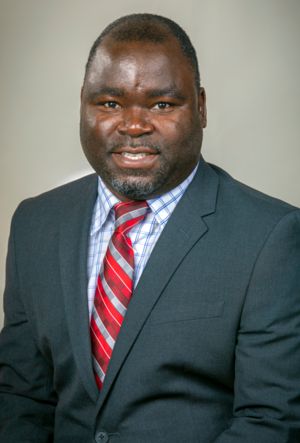
Blessing Masasi, Ph.D. Assistant Professor, Dept. of Natural Resources & Environmental Design bmasasi@ncat.edu
Blessing Masasi, Ph.D., knows water, but he is always trying to know it better — especially when it comes to learning how to manage it for agricultural uses.
As an assistant professor of biological engineering in N.C. A&T’s College of Agriculture and Environmental Sciences, he aims to help farmers manage agricultural water use more efficiently as they adapt to extreme weather events, including deluges, droughts and rising temperatures.
“Water is one of the biggest challenges in agriculture, especially as extreme weather events become more common,” Masasi explained. “Even here in North Carolina, where we have significant annual rainfall, it doesn’t always come when crops need it most.”
Masasi joined N.C A&T in 2023, and he teaches and conducts research related to agricultural water management with a pragmatic focus:
“I’m an agricultural engineer,” he said. “My passion is helping farmers tackle real-world problems – especially how and when they use water.”
His research group is small but mighty, consisting of two graduate students – Ph.D. student Olabisi Somefun and master’s student Anuoluwapo Adelabu – as well as a handful of undergraduates. Together, they’re investigating how precise, timely irrigation methods can help farmers adapt to increasingly unpredictable rainfall.
“Farmers in the Southeast face different problems than those in the dry West,” Masasi said. “It’s not just about how much rain you get but when. That variability is a real threat to crop yields.”
Seeing Below the Surface
Traditionally, irrigation scheduling decisions have relied on visual cues, such as looking for yellowing or wilting leaves.
“But by the time you see a wilted plant, the crop is already under stress, which results in yield loss,” Masasi noted. “That’s where technology comes in.”
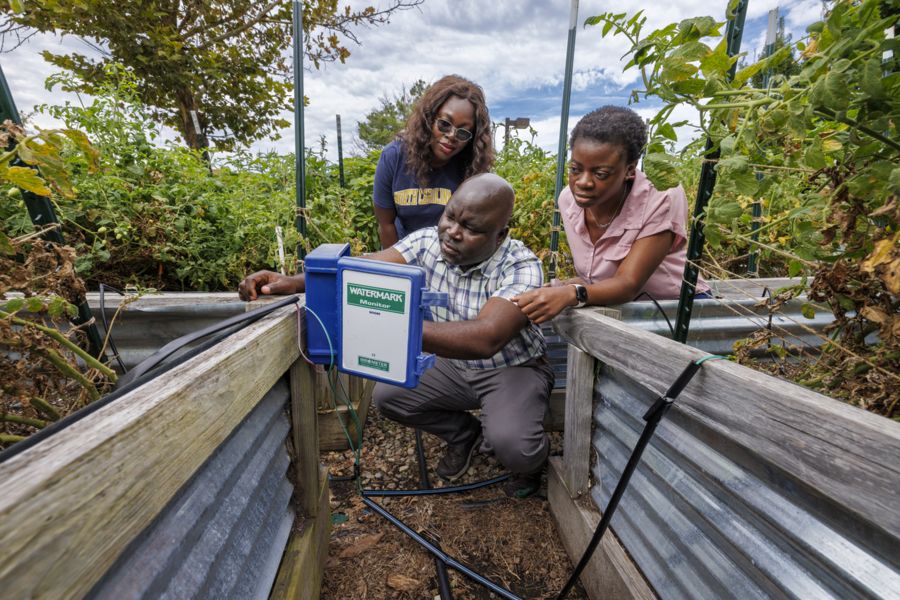
The team’s research focuses on soil moisture sensors, devices that delve below the surface to measure either the actual amount of water in the soil or its “matric potential” (the resistance to water uptake by plant roots in the soil.) The group installed these sensors in raised tomato beds on campus, experimenting with different watering thresholds. A grant from the U.S. Department of Agriculture’s National Institute of Food and Agriculture supports the work.
“We’re comparing three treatments: watering when the soil is just starting to dry out; letting it get drier; and the traditional method of watering based on what the plant looks like,” Masasi explained.
The sensors available on the market range from low-cost tensiometers, which measure soil matric potential; to time domain reflectometers (TDRs), which use electromagnetic waves to measure soil moisture; to a $10,000 device that causes neutrons to collide with other particles in the soil and measures moisture levels by measuring the density of the resulting neutron “cloud.”
“Last year, we saw that watering every day led to taller tomato plants,” said Somefun. “But interestingly, that didn’t translate into higher yields – the number and size of tomatoes were about the same, even if we watered less often. That means there’s a real opportunity to save water without significant yield reduction.”
Precision agriculture is often associated with expensive, high-tech gadgets, but Masasi’s team is making sure their research benefits small farms with more limited resources, too.
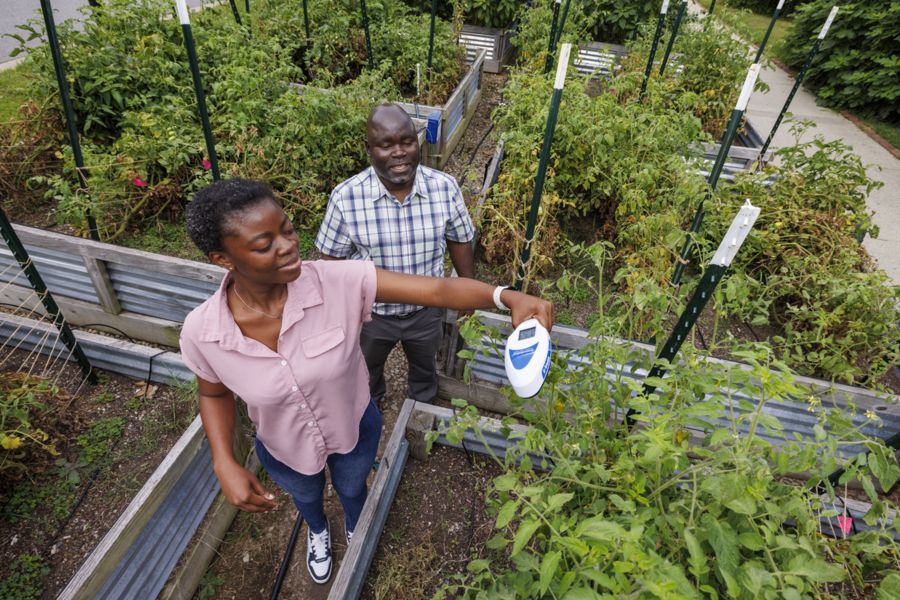
Masasi and graduate student Anuoluwapo Adelabu check hydration levels in tomato plants using a GreenSeeker handheld device that instantly calculates the Normalized Difference Vegetation Index (NDVI), which represents the health of the plant.
“There are Watermark electrical resistance sensors that cost $45 and come with a simple handheld reader,” he said. “For small operations, that’s a game changer.”
Another key to better water use is thoughtful placement of the soil moisture sensors, said Masasi. Choosing locations with the dominant soil type in the field and utilizing established databases, such as the USDA Web Soil Survey, can help farmers maximize effective water use.
“You don’t just install sensors anywhere,” Masasi emphasized. “It’s about understanding your soil, your crop and your unique microclimate. That’s how you get the most from every drop.”
Changing Attitudes, Making a Difference
Adopting the new technology is still tricky, especially for small farmers who are skeptical about the costs or complexity. Masasi credits Cooperative Extension at N.C. A&T, with its field days and hands-on demonstrations, with increasing knowledge and building trust.
“We’ve had farmers come out to see these trials,” he said. “Seeing is believing. Once they understand how these tools work, and the cost savings from not overwatering, they’re eager to try.”
The team’s outreach includes presentations to Extension agents, who then share with farmers across the state.
“We want this research to matter,” Masasi said. “It’s not enough to publish papers; we have to get these practices into the fields where they can make a difference.”
While early results are promising, Masasi is careful not to overstate his team’s findings. “This is our second year – we need another season of data before making firm recommendations,” he said. But the implications are already clear: smarter irrigation saves water, money and labor while reducing environmental impacts such as nutrient runoff.
There’s also a high-tech side to the project: computer crop modeling, which uses local weather and soil data to simulate outcomes for different irrigation scenarios. “Instead of years of costly field trials, we can run experiments on a computer,” Masasi said. “That kind of precision is the future of agriculture, especially as extreme weather events become more frequent.”
While their current field trials focus on tomatoes, the team’s methods apply to a wide array of crops. “The specifics, such as what moisture level to irrigate at, will differ by crop,” Masasi said. “But the logic of using data to drive decisions is universal.”