Scientists in the College of Agriculture and Environmental Sciences are pioneering new solutions for manure management and clean energy.
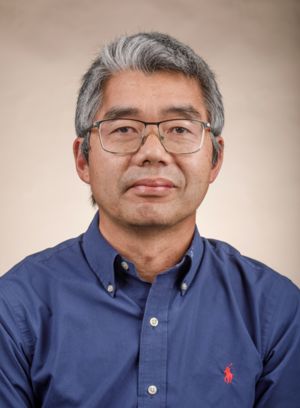
Lijun Wang, Ph.D. Professor, Dept. of Natural Resources & Environmental Design lwang@ncat.edu
In 2010, poultry surpassed beef as the most consumed meat in the nation. But the demand for more affordable, leaner protein and the versatility of eggs also mean mountains of nutrient-rich waste, notorious for creating both environmental headaches and complicated disposal logistics.
Today at N.C. A&T’s College of Agriculture and Environmental Sciences, Lijun Wang, Ph.D., a professor of biological engineering, conducts research that promises to unlock the commercial and environmental potential of what was once considered mere litter.
“Chicken manure has always been both a curse and a blessing for farmers,” Wang explained. “The nutrients can support crop growth, but without careful management, we risk polluting water, wasting valuable resources, and missing cost savings or renewable energy opportunities.”
Chicken farming produces manure with high moisture content, high levels of nitrogen, and a rich mineral profile. Traditionally, using it directly as a fertilizer can lead to gas emissions, contamination from pathogens and antibiotics, and pollutant run-off in waterways. “The high nitrogen content is great for plant growth, but during waste handling or digestion, it often turns into ammonia, whose release into the air creates strong odors and contributes to greenhouse gas issues,” Wang said.
To tackle these problems, Wang’s team and other collaborators have been fine-tuning both the chemistry and engineering behind poultry manure valorization — transforming waste into fertilizer, fuel and more.
In one project, the team explored a dual-step chemical pretreatment using acidic and alkaline leaching before hydrothermal carbonization (HTC) — an energy-intensive process in which wet manure is heated under pressure to create a solid fuel called hydrochar. This sequential treatment, Wang explained, “let us separate out valuable nutrients in a liquid phase that can be used as a concentrated fertilizer, while also producing a solid hydrochar with significantly less ash and nitrogen, and much more energy value.”
The results were striking: More than 95% of phosphorus and most of the other nutrients were successfully captured, yielding a liquid that can be reapplied to crops. Meanwhile, the treated manure was effectively converted into hydrochar with only 3% ash — compared to 30% in untreated manure — and an energy content rivaling that of commercial coal. With carbon additives like activated carbon, the process retained even more energy and carbon, making the resulting biofuel more efficient.
“It’s a huge step forward for farmers dealing with excess manure. We’re getting two valuable products out of one waste stream: a high-quality, low-ash and low-nitrogen fuel, and a nutrient-rich liquid fertilizer. It’s essentially a small-scale circular economy,” Wang said.
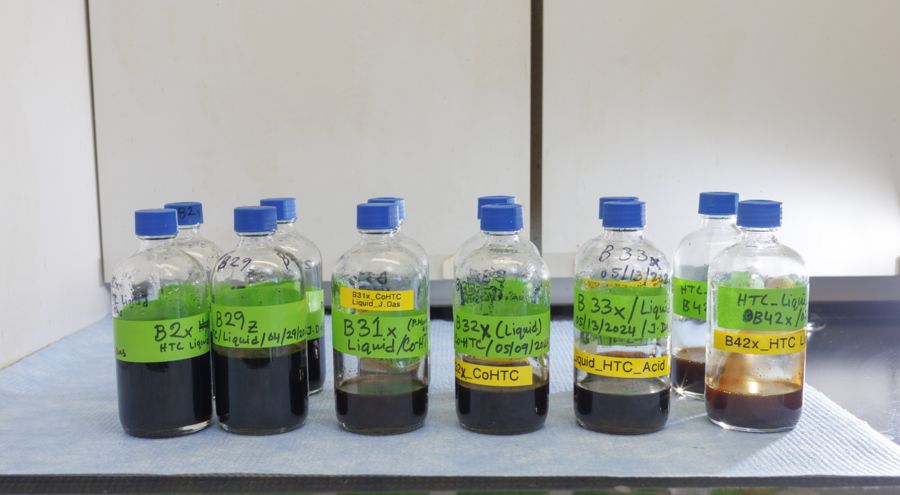
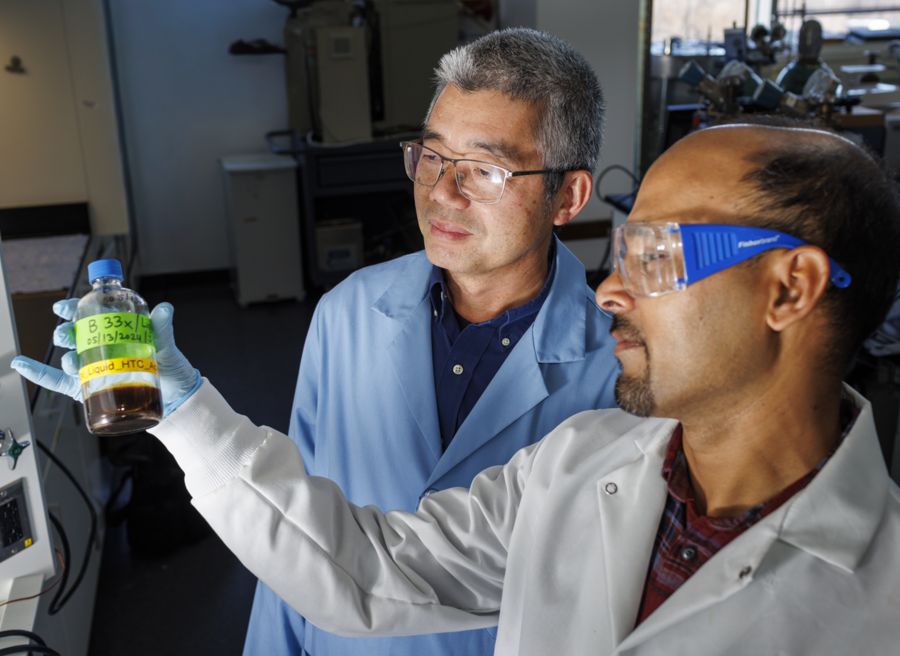
Samples of extracted nutrients from chicken manure await evaluation. Waste can be transformed into fertilizer, fuel and more, according to Wang.
A second research effort focuses on the anaerobic digestion (AD) of chicken manure, a process where bacteria break down the waste in oxygen-free conditions to produce methane-rich biogas. While an established technique, AD can falter when faced with the tricky chemical balance of chicken waste — notably, its low carbon-to-nitrogen ratio, which can lead to excess ammonia production that in turn inhibits microbial activity and reduces biogas production.
To address this, Wang’s team devised a special biocomposite hydrogel that incorporates iron-modified biochar at the microscopic level. When just a small amount (0.66% by weight) of this hydrogel was mixed with chicken manure in the digester, methane yields shot up by 34%. More impressively, the biogas produced contained significantly less hydrogen sulfide and carbon dioxide — both undesirable byproducts that lower energy quality and complicate gas cleanup.
“Our hydrogel acts like a little toolbox; it anchors the microbes, helps nutrients flow better and even buffers out some of the toxic byproducts,” Wang said. “It’s more effective than adding each ingredient separately, and it’s cheap and scalable.”
Both lines of research strike at the heart of agriculture’s waste dilemma: How do we turn what’s abundant and problematic — such as poultry manure — into resources that support sustainable farming and cleaner energy?
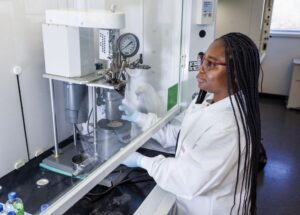
Dorcas Amoh, a doctoral student working with Wang, runs an experiment at the laboratory. The group is studying ways that anaerobic digestion offers in creating renewable energy with less odor.
Anaerobic digestion already offers multiple benefits: waste reduction, odor control and climate-friendly renewable energy in the form of biogas. With further optimization, the technology could let farms create their own electricity, vehicle fuel, even replacement cooking gas. The byproducts — solid and liquid residues — remain highly desirable organic fertilizers.
“If we can make biogas cleaner and more abundant, farms become less dependent on fossil fuels and less prone to the shocks of fertilizer price swings,” Wang said. “Plus, every bit of methane we use for energy is methane that’s not escaping into the atmosphere.”
From a broader perspective, these advances pave the way for more resilient, circular farming. As regulatory pressure mounts and farmers seek new revenue streams, methods to turn manure into value rather than pollution could soon become indispensable.
Both leaching and hydrogel-aided digestion are poised for larger-scale tests.
“Our next steps will be working with commercial poultry operations and seeing how these solutions perform outside the lab,” Wang said. The hope is that future farms will not only tame their manure problem but transform it into a profit center, all while promoting sustainability and keeping harmful waste out of air and water supplies.
“In waste, there’s always opportunity if you know how and where to look for it.”